What Makes an Effective Sticker Design? A Business Owner’s Complete Guide
By Rogue Stickers
Most business owners think about sticker design the wrong way.
They open their brand guidelines, drop their logo onto a square template, pick a background color, and send it to print. The result is a sticker that looks fine, but one that nobody actually wants to put on their laptop, their water bottle, or their car. It sits in a bowl on the counter, gets occasionally grabbed by a polite customer, and quietly disappears into a drawer.
Effective sticker design is not logo design. It’s not ad design. It’s not even packaging design. It’s a discipline with its own rules, its own success criteria, and its own psychology — and business owners who understand those rules consistently outperform competitors who treat sticker design as an afterthought.
This guide breaks down exactly what separates a sticker that people keep and display from one that ends up in the trash, and how to apply those principles to your own brand.
Why Sticker Design Requires a Different Mindset
Before diving into principles, it’s worth reframing what you’re actually trying to accomplish with a sticker design.
A banner ad is trying to interrupt someone into clicking. A product label is trying to communicate information and drive a shelf decision. A sticker is trying to do something much harder: it’s trying to convince someone to voluntarily display your brand on their personal belongings as an expression of their identity.
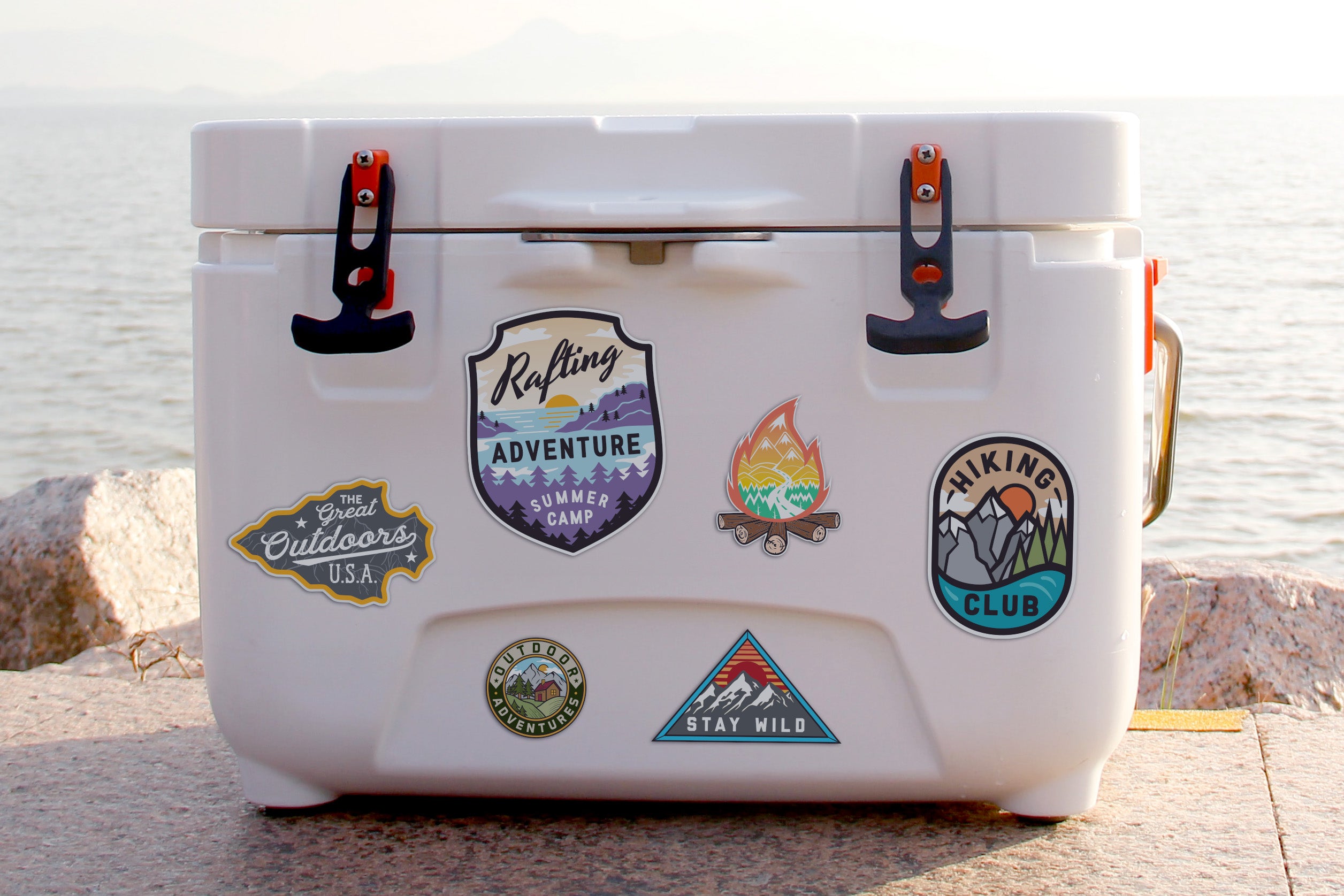
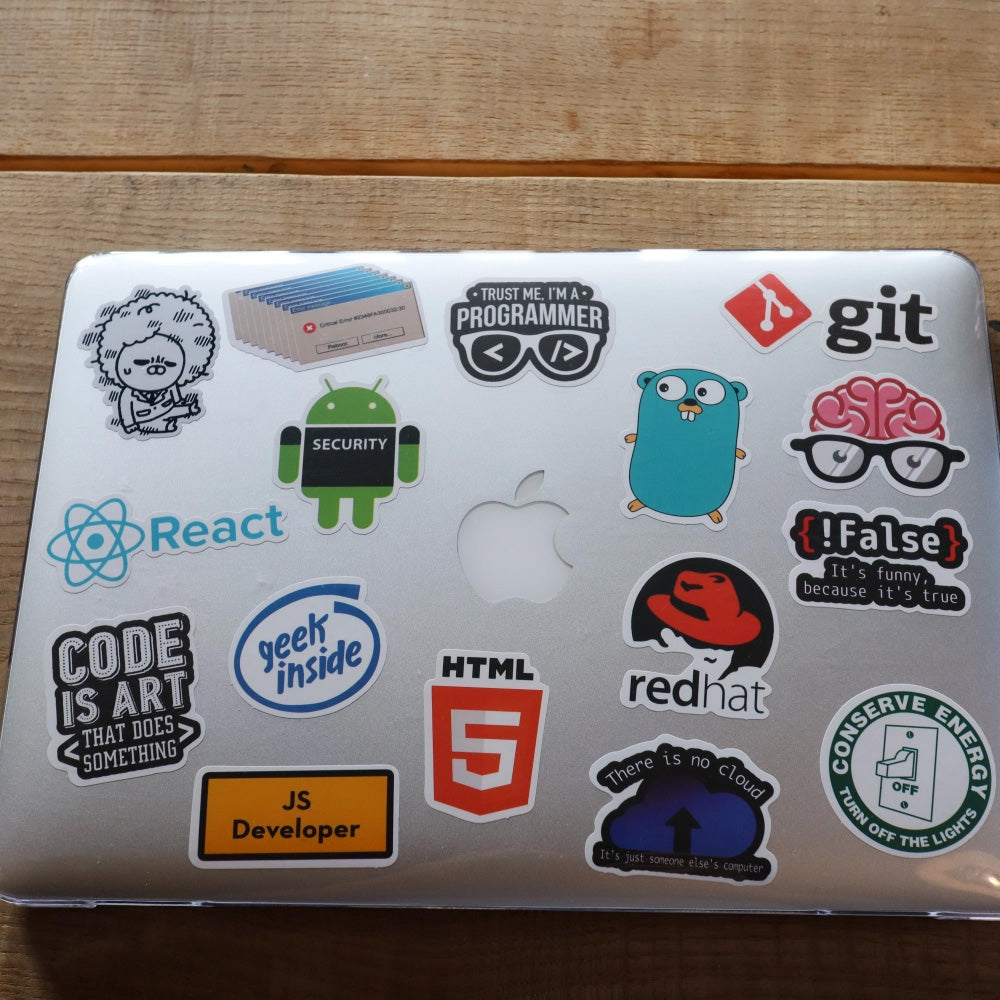
That’s an extraordinary ask. People are deeply selective about what goes on their laptop lid or their Nalgene. Those surfaces are curated self-portraits. Every sticker on them was chosen because it communicates something the owner wants the world to know about them, their values, their humor, their tribe, their aesthetic.
Your sticker isn’t competing with other brand stickers. It’s competing with every other sticker a person finds appealing. It needs to earn its place purely on the strength of its design, personality, and cultural resonance. The brand association is secondary, if the design is good enough, the branding comes along for the ride.
This mindset shift, from brand communication to object someone wants to own, is the foundation of every great sticker design decision.
The 7 Principles of Effective Sticker Design
1. Simplicity Always Wins
The most common mistake in sticker design is trying to include too much. Business owners want their logo, their tagline, their website, their phone number, their color palette, and their core brand message — all on a 2-inch circle.
The result is visual noise. From any distance greater than arm’s length, the design collapses into an unreadable smudge. On curved surfaces like water bottles, complex designs become even more distorted and illegible.
The best sticker designs are radically simple. They identify the one thing — one image, one phrase, one icon — that best represents the brand’s personality and build the entire design around it. Everything else is ruthlessly cut.
Ask yourself: if someone sees this sticker from across a coffee shop, what will they register? If the answer is “not much,” simplify until there’s only one clear visual idea left.
Great references for this principle: the Nike swoosh sticker, the Apple logo sticker (so simple it shipped inside every Mac for decades), or any of Patagonia’s mountain silhouette designs. One strong, instantly recognizable visual. Nothing more.
2. High Contrast Is Non-Negotiable
Stickers live in unpredictable environments — under fluorescent office lights, in bright outdoor sun, on dark laptop lids, on light-colored walls. A design that looks beautiful on your monitor at home may become nearly invisible in real-world conditions.
High contrast between foreground elements and background ensures your design remains legible across all these environments. This means:
- Dark design on light background or light design on dark background — avoid middle-ground combinations where neither element pops.
- Bold, thick letterforms rather than thin, delicate typography that disappears at small sizes.
- Solid fills over gradients, especially for text and key graphic elements. Gradients can look stunning on screen and muddy on vinyl.
- Enough breathing room around key elements so they read clearly without crowding.
Test your design by printing a small version in black and white. If it loses legibility, the contrast needs work.
3. Typography Must Work at Small Scale
If your sticker includes text — and many of the best ones do — typography is one of the most technically demanding aspects of the design.
Type that looks elegant and refined at large display sizes often becomes illegible at sticker scale. Fine serifs disappear. Tight letter spacing causes letters to bleed together. Decorative scripts become unreadable swirls.
Effective sticker typography follows these rules:
Choose bold, clear typefaces. Sans-serif fonts with consistent stroke width (like Futura, Gotham, or even a well-chosen geometric display font) tend to hold up at small sizes. If you’re using a branded serif, test it carefully at actual sticker dimensions.
Limit text to the essential. If you can’t read it at arm’s length in three seconds, cut it. This usually means a maximum of one short phrase, a brand name, or a single tagline — not multiple lines of copy.
Size up letter spacing slightly. Slightly more space between letters than feels natural at large sizes helps readability when the design is reduced.
Avoid text smaller than 8 points in the final printed size. Below that threshold, text on vinyl tends to fill in and blur, especially if the printing process involves any ink spread.
4. Choose a Shape That Enhances the Design
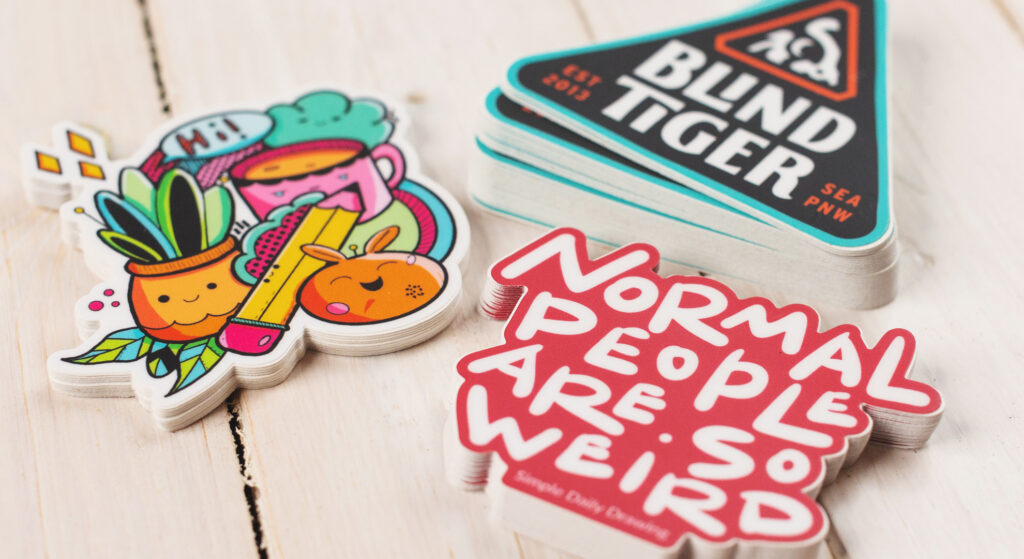
Most business owners default to a rectangle, square, or circle — and then design within those constraints. But die-cut stickers, which are cut to the precise shape of the design itself, are often far more effective because the shape becomes part of the visual impact.
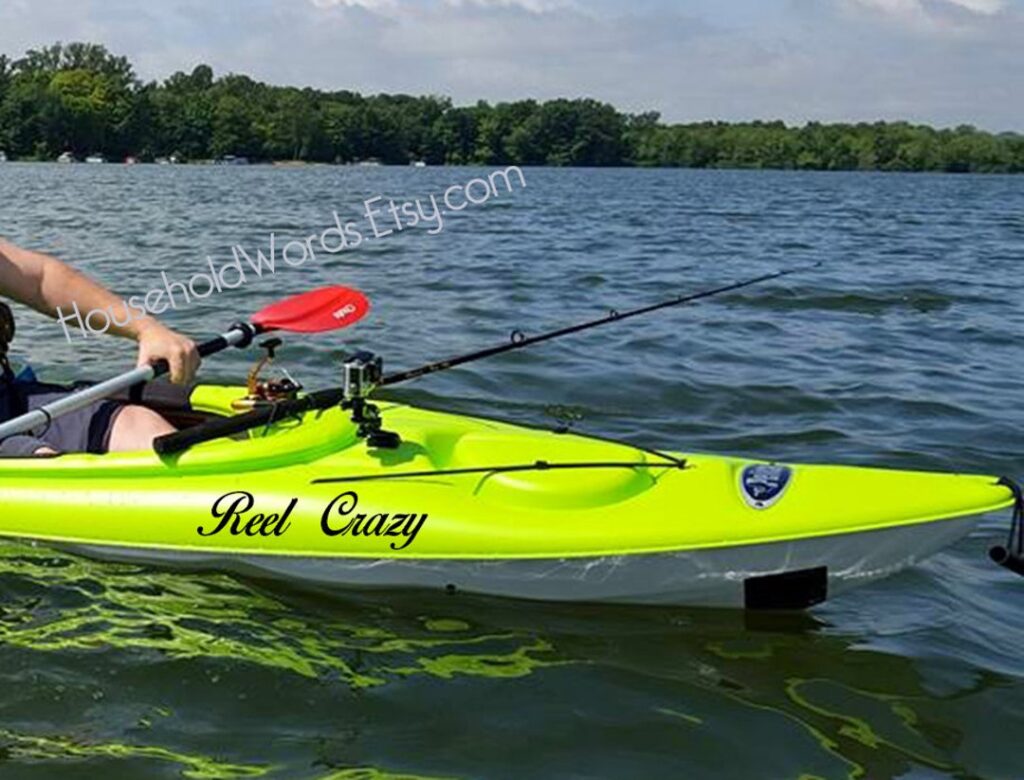
A die-cut sticker of a mountain silhouette, a coffee cup, a lightning bolt, or a stylized animal feels more finished and intentional than the same design floating inside a rectangle. It looks like a designed object rather than a piece of paper with something printed on it.
Consider how the shape of your sticker communicates personality. Round shapes feel friendly and approachable. Sharp angles and irregular forms feel edgy and dynamic. Organic, irregular outlines feel natural and hand-crafted. The shape is doing design work before the viewer even processes the imagery or text.
If budget is a concern, start with die-cut. The premium over standard shapes is small at volume, and the difference in perceived quality is significant.
5. Color Strategy: Stand Out Without Chaos
Color is one of the most powerful tools in sticker design — and one of the most frequently misused.
Many business owners feel compelled to reproduce their full brand color palette on every sticker. The result is often a visually noisy design that competes with itself. Effective sticker color strategy is usually more restrained:
One or two dominant colors. The most memorable sticker designs rarely use more than two or three colors. Each additional color adds complexity and reduces visual impact.
Consider the surfaces where stickers live. Laptop lids tend to be silver, black, or white. Water bottles are often black, white, or metallic. Car bumpers are body-colored. A sticker that pops against most of these backgrounds will get displayed more than one that blends in.
Use white or transparent as your friend. A clean white background makes almost any color combination pop. Alternatively, a clear/transparent sticker with opaque elements allows the surface underneath to become part of the design — a sophisticated approach that feels premium.
Neon and high-saturation colors attract attention. For brands targeting younger demographics or visual subcultures like skateboarding, streetwear, or outdoor sports, saturated, almost-aggressive color choices signal cultural belonging.
Muted, earthy palettes signal quality and craft. For premium food and beverage brands, artisan producers, or lifestyle brands positioning on authenticity, restrained earthy palettes communicate taste and refinement.
Always proof physical color samples before your full print run. Colors render very differently on vinyl than they appear on screen.
6. Personality Over Perfection
Here is the design truth that most business owners find hardest to accept: a sticker with a strong personality and imperfect execution will outperform a technically flawless sticker with no character every single time.
People display stickers to express who they are. They’re not drawn to perfection — they’re drawn to personality. To voice. To something that feels human rather than corporate.
This is why the most beloved brand stickers often lean into humor, irreverence, specificity, or creative weirdness rather than polished professionalism. A craft brewery whose sticker says “Beer O’Clock Somewhere” will get more organic placements than one that produces a pristine rendering of their logo on a white oval. A local running shop whose sticker reads “0.0 — Just Kidding” connects with its community in a way that a corporate logo never can.
The question to ask is: does this sticker feel like it came from a human, or does it feel like it came from a committee? The former gets displayed. The latter gets discarded.
This doesn’t mean sloppiness is a virtue — execution quality still matters. But personality is the soul of effective sticker design, and it should guide every creative decision.
7. Design for the Long Game
Stickers are one of the few marketing assets that can outlast the campaign that created them. A sticker applied to a laptop in 2024 might still be generating impressions in 2028. That longevity is a major advantage — but it also means design decisions made today have a long tail.
Effective sticker design avoids elements that date quickly: trend-dependent visual styles (think of designs that scream “this was made during a specific era”), topical cultural references that lose meaning over time, or specific product names or offers that may change.
Instead, lean toward timeless visual concepts — strong graphic forms, wit that transcends the moment, imagery rooted in the brand’s enduring identity rather than its current campaign. The sticker should represent what your brand will still stand for five years from now.
This is also why limited-edition sticker series can be a smart strategy: they allow you to create timely, trend-responsive designs under a separate banner while keeping your core sticker range evergreen.
Common Sticker Design Mistakes to Avoid
Even experienced designers make these errors when working on stickers specifically. Watch for them in your own review process.
Too many elements competing for attention. Logos, taglines, websites, social handles, QR codes — each element added dilutes the impact of all the others. Pick one primary element and support it with at most one secondary element. Nothing more.
Designing at large scale and reducing without testing. A design that looks great at 10 inches may become illegible at 2 inches. Always proof your design at actual print size — printed on paper if necessary — before committing to a production run.
Ignoring bleed and safe zones. For die-cut stickers especially, elements placed too close to the edge risk being cut off in production. Work with your printer’s templates and respect their bleed guidelines.
Choosing fashionable over functional typography. The ultra-thin, delicate display fonts trending in brand design right now are often terrible choices for sticker applications. Prioritize legibility over on-trend aesthetics.
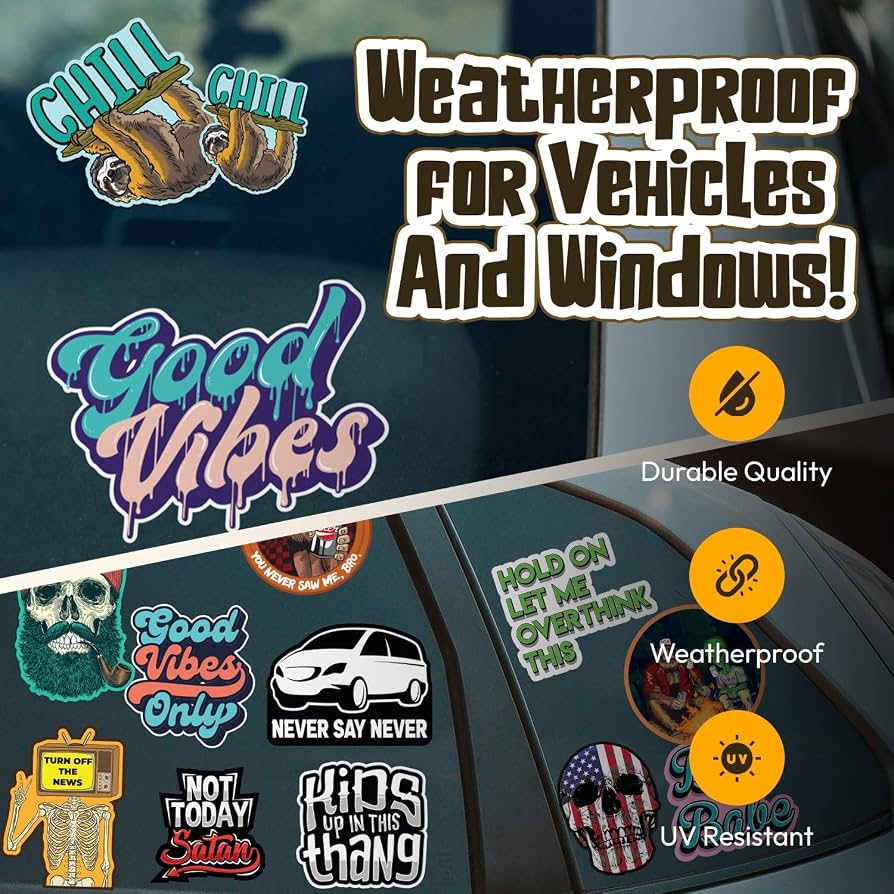
Neglecting material choice. A beautifully designed sticker on cheap paper stock signals a cheap brand. Weatherproof vinyl, quality lamination, and appropriate finish (matte vs. gloss vs. holographic) are as much a part of the design as the artwork itself. Match the material to your brand positioning.
Using raster images at low resolution. Sticker printing exposes every pixel of a low-resolution image. All artwork should be delivered as vector files (AI, EPS, or SVG) or as high-resolution raster files (minimum 300 DPI at print size). Never scale up a logo saved from a website — the results will be visibly poor.
Working With a Designer vs. Doing It Yourself
If you have design skills or access to quality tools, creating your own sticker artwork is absolutely viable — especially for simple typographic or icon-based designs. Platforms like Adobe Illustrator, Affinity Designer, or even Canva (for simpler applications) can produce solid results when you understand the principles above.
However, if your brand’s visual identity is core to your competitive differentiation — if the way your brand looks is a significant part of why customers choose you — working with an experienced graphic designer is worth the investment.
When briefing a designer, give them this single clear objective: design something people will genuinely want to put on their belongings. Not something that communicates your brand messaging. Not something that fits neatly into your brand guidelines. Something a person would choose to display as a piece of their identity. That brief produces very different — and far more effective — results.
From Design to Print: Final Checklist
Before sending your sticker design to production, work through this checklist:
- Is the design legible at actual print size, viewed at arm’s length?
- Is there strong contrast between foreground and background elements?
- Have you proofed all text for spelling, spacing, and size?
- Is all artwork provided in vector format or at minimum 300 DPI?
- Have you accounted for bleed and safe zone requirements?
- Does the die-cut shape (if applicable) enhance rather than distract from the design?
- Have you ordered a physical proof before committing to the full print run?
- Does the material and finish match your brand’s positioning?
- Does the design have a personality distinct from a generic corporate logo treatment?
- Will this design still feel relevant and on-brand in three to five years?
If you can answer yes to all ten, you’re ready to print.
The Bottom Line: Design That Earns Its Place
The business owners who get the most value from sticker marketing are not the ones who spend the most on printing — they’re the ones who invest in designs that people actually want. A single exceptional sticker design, printed well and distributed thoughtfully, will generate more brand equity than a dozen mediocre ones.
Great sticker design is simple, high-contrast, appropriately typeset, interestingly shaped, strategically colored, full of personality, and built to last. It asks not “does this represent our brand?” but “would someone choose to make this a part of their identity?” — and it doesn’t stop until the answer is genuinely yes.
Get that right, and your stickers will do the rest.
Thinking about creating your first custom sticker or refreshing an existing design? Start with one strong concept, brief a skilled designer with a human-centered objective, and always proof physically before printing at scale. A sticker done right is one of the most cost-effective brand investments you’ll ever make.
Read our sticker artwork preparation guide and proofing FAQ. For questions about a specific application, contact Rogue Stickers before ordering.